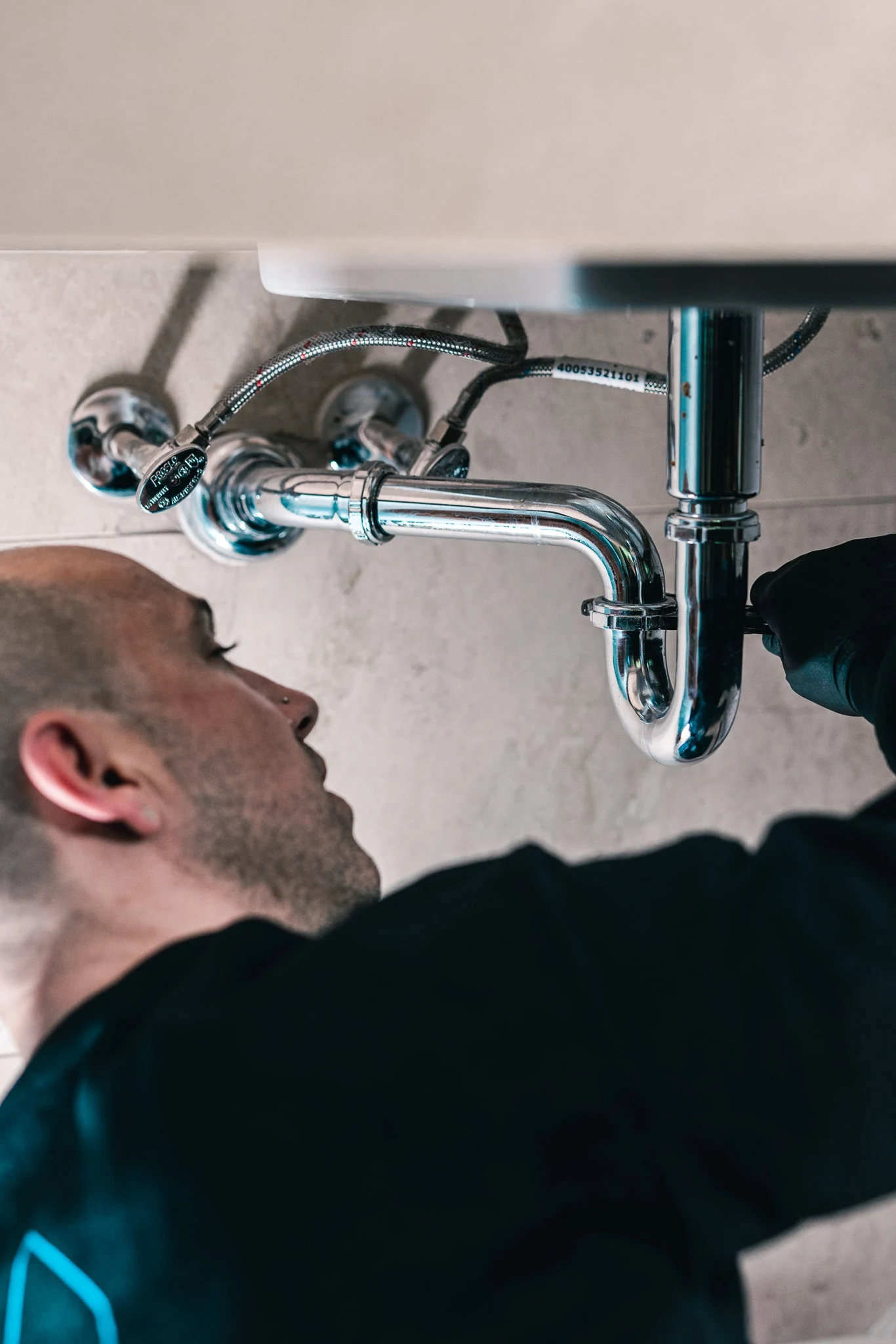
Plumbing work looks straightforward from the outside. Turn a fitting, replace a part, clear a drain. The physical reality is different. Pipes carry pressurized water, chemical residue, sharp metal edges, and in drain systems, contaminated wastewater that contains bacteria, mold spores, and in some cases sewage pathogens. The space where plumbing work happens, under sinks, inside wall cavities, in crawl spaces and mechanical rooms, adds confined space, poor lighting, and awkward working positions to the equation.
Ontario's Occupational Health and Safety Act and the Ontario Ministry of Labour, Immigration, Training and Skills Development both recognize plumbing-related work as carrying elevated injury risk from chemical exposure, musculoskeletal strain, and contact with contaminated water. These risks apply to licensed tradespeople working with full training and proper equipment. For homeowners, the risk is compounded by unfamiliarity with the work environment and the systems involved. The right gear does not eliminate risk entirely, but it is the difference between a manageable task and a preventable injury.
Before reviewing the gear list, it is worth reading our resource on common DIY plumbing repairs to understand which projects homeowners can reasonably tackle and which require a licensed plumber regardless of equipment.
The following items represent the minimum baseline protection for any plumbing task in a residential setting. These apply whether you are replacing a faucet, unclogging a drain, or inspecting a pipe under a sink.
Eye protection is non-negotiable for any plumbing task. Pressurized water, drain cleaning chemicals, pipe sealant, and debris from cutting or threading pipe can all cause serious eye injury without warning. Safety glasses with side shields provide adequate protection for most tasks. When working with drain cleaners, solvents, or PVC cement, sealed goggles that prevent splash entry from all angles are the correct choice. Look for eyewear rated to the CSA Z94.3 standard for Canadian residential applications. This is the Canadian standard equivalent to the ANSI Z87.1 rating commonly referenced on product packaging.
Plumbing tasks expose hands to drain water, pipe sealant, PVC cement, thread compound, and in drain work, contaminated wastewater. Standard rubber household gloves provide basic protection for light work. For drain cleaning, working with PVC solvent cement, or any contact with drain or sewer water, nitrile or neoprene gloves with chemical resistance are the appropriate choice. These gloves resist degradation from solvents and adhesives that deteriorate standard rubber. Gloves should extend past the wrist to prevent splash contamination on skin.
Open footwear, flip flops, and socks are not appropriate for any plumbing task. Dropped tools, pipe fittings, and wet flooring create slip and impact hazards. Work boots or sturdy closed-toe shoes with non-slip soles provide the necessary protection. Steel-toed footwear is advisable if working with heavy pipe sections, cast iron fittings, or any material that could cause a crush injury if dropped.
Plumbing work involves contact with dirty water, pipe compounds, and adhesives that do not wash out of everyday clothing. More importantly, loose sleeves and dangling drawstrings can catch on fittings, pipe edges, or rotating tool components. Wear close-fitting clothing that covers the arms and legs. This also provides a layer of protection against drain water splash and pipe compound contact on skin.
Beyond the baseline, certain tasks demand additional protection based on the specific hazard involved.
Any plumbing task that disturbs older pipes, insulation around pipe runs, or drain access points in homes built before 1990 carries a risk of asbestos or mould exposure. Asbestos was used in pipe wrap insulation in Canadian homes until the late 1980s, and older homes in Mississauga, Toronto, and across the GTA may have this material present around boiler pipes, duct wrap, and floor tile adhesive near plumbing fixtures.According to the U.S. Environmental Protection Agency's asbestos guidance, a standard dust mask does not filter asbestos fibres. An N95 respirator rated by the National Institute for Occupational Safety and Health is the minimum for disturbed insulation. If asbestos is suspected, stop work immediately and contact a licensed abatement professional before continuing.
Drain work that opens a main line access point or sewer cleanout also releases hydrogen sulfide gas and methane from sewer systems. These gases are odorous at low concentrations but dangerous at higher levels. Work in a ventilated area with a window open or a fan running whenever a sewer cleanout or main drain is opened. A respirator with organic vapour cartridges provides protection for brief exposure during drain access work.
Replacing toilet wax rings, working on floor-level drain connections, and accessing under-sink plumbing all require extended time on hard flooring. Knee pads distribute body weight and protect the kneecap and surrounding tissue from sustained pressure on tile, concrete, and hardwood. This is a low-cost item that prevents the kind of repetitive strain injury that accumulates over a single extended work session.
Angle grinders, reciprocating saws, and drain snaking machines all exceed safe noise exposure levels with extended use. Foam earplugs or over-ear hearing protection rated at 25 dB noise reduction or higher are appropriate for any task involving power tools. Brief use of power tools during a simple task does not typically require hearing protection, but any task lasting more than 20 to 30 minutes with consistent power tool noise warrants it.
Working in crawl spaces, accessing basement ceiling pipe runs, and reaching into mechanical rooms with low overhead clearance all create impact hazard for the head. A bump cap, which is lighter than a hard hat but provides surface protection, is practical for confined residential work areas. A full hard hat is appropriate if overhead pipe work is involved in a renovation context.
For drain cleaning tasks, opening cleanout caps, and any work on fixtures that contain standing water, a waterproof apron or splash bib prevents contaminated drain water from soaking through clothing to skin. This is especially relevant when working on kitchen drain connections where grease-laden water is present, or bathroom drain traps where biofilm accumulation is common.
Use the table below to identify the appropriate gear for each common DIY plumbing task.
Ontario's Building Code Act and the Plumbers Act regulate what plumbing work requires a licensed plumber. Homeowners are permitted to perform certain minor repairs in their own residences without a licence, but the scope is more limited than many people assume.
Tasks that are generally considered within homeowner scope for a primary residence include replacing faucet cartridges and aerators, replacing toilet flappers and fill valves, replacing the wax ring on an existing toilet, swapping a P-trap under a sink, and clearing drain blockages with a plunger or hand auger. These involve no new pipe installation, no connection to the building's drain-waste-vent system in a structural sense, and no work requiring a permit.
Tasks that require a licensed plumber in Ontario include any new pipe installation or extension, any work on the main drain-waste-vent stack, any connection to the municipal water service or sewer lateral, installation of new fixtures in a renovation, and all gas line work regardless of scope. If you are unsure whether your planned task falls within homeowner scope, contact Galaxy Plumbing Inc. before beginning. Starting work that requires a permit without one creates legal liability and can complicate home insurance claims if damage occurs.
Our post on DIY drain projects homeowners can tackle covers specific drain-related tasks with step-by-step guidance and clear indicators for when professional equipment is needed.
The single most common source of serious water damage during DIY plumbing is starting work without shutting off the water supply to the fixture or the home. Even slow-drip connections can release significant water when a fitting is loosened. Always locate and close the isolation valve for the fixture before beginning any work. If the isolation valve is seized or does not stop flow, shut off the main supply. Our guide to recognizing signs of a pipe about to fail explains how to identify isolation valve problems before they become emergencies.
Sodium hydroxide and acid-based drain cleaners cause immediate and severe chemical burns on contact with skin and eyes. Many homeowners pour these products without any eye or hand protection. The splash risk is real, particularly when pouring into a fixture with standing water or when the product reacts and produces heat. Always wear sealed goggles and chemical-resistant gloves when handling these products. Our post on why chemical drain cleaners damage pipes also explains why professional drain cleaning is both safer and more effective for most blockage types.
Drain water, even from kitchen and bathroom fixtures, contains bacteria, mold spores, and biofilm. Sewer-connected drain lines in homes with partial blockages or backflow conditions contain pathogens. Any skin contact with drain water should be followed by thorough washing with soap and water. Open cuts or wounds should be covered with waterproof bandages before any drain work. Contact with sewage water warrants medical attention if exposure occurs.
Under-sink cabinets, crawl spaces, and mechanical rooms with limited air circulation concentrate chemical vapours from PVC cement, thread compound, and pipe sealant products. These vapours cause dizziness, headache, and respiratory irritation with brief exposure and can be dangerous with sustained exposure in unventilated spaces. Open windows, run a fan to move air through the workspace, and take regular breaks to fresh air when working with adhesive or solvent products.
Most DIY plumbing injuries occur during brief tasks where the homeowner judged that full gear was not worth putting on. Eye injuries from splash events happen in a fraction of a second. Chemical burns from drain products happen on first contact. The time to put on safety glasses and gloves is measured in seconds. The consequences of skipping them are not proportional to the perceived convenience of doing so.
Knowing when to stop is as important as knowing what gear to wear. The following situations indicate that a task has moved beyond homeowner scope, regardless of equipment or confidence level.
Safety gear is the starting point for any DIY plumbing project. Safety glasses, chemical-resistant gloves, closed-toe footwear, and task-appropriate additional protection are the foundation of responsible homeowner plumbing work. Equally important is the judgment to recognize when a task has moved past homeowner scope and into licensed plumber territory. Galaxy Plumbing Inc. serves homeowners and property managers across Mississauga, Toronto, Etobicoke, Scarborough, Oakville, Vaughan, and Richmond Hill with professional plumbing and HVAC services for every task that goes beyond DIY. Explore our full range of plumbing services or contact our team to schedule a service visit.
For the tasks within homeowner scope, consumer-grade tools are generally sufficient. A basin wrench, adjustable pliers, plumber's putty, Teflon tape, and a hand auger handle the majority of fixture-level repairs effectively. Professional-grade equipment, including motorized drain snakes, pipe threading machines, and camera inspection systems, are used by licensed plumbers for tasks that go beyond homeowner scope. If the job requires equipment you would need to rent or purchase specifically, that is a strong indicator that it should be handled professionally. Our team provides professional drain cleaning and inspection services across the GTA.
Visual inspection alone cannot confirm the presence of asbestos. Asbestos-containing materials in older Canadian homes include pipe wrap insulation on boiler pipes (often grey or white corrugated wrap), floor tile adhesive, and certain wall and ceiling materials near mechanical rooms. Homes built before 1985 in the GTA carry elevated risk. If you are opening walls or accessing pipe insulation in a pre-1985 home, do not disturb any insulation material until an accredited asbestos inspector has assessed the area. Work that disturbs asbestos without abatement is illegal under Ontario's Occupational Health and Safety Act.
A hand-operated drain snake or closet auger is a safe and effective tool for homeowner use on fixture-level clogs when used correctly. The key safety rules are: wear eye protection and gloves, do not force the cable if significant resistance is felt (this can indicate a pipe joint or fitting rather than a clog), and do not use a standard drain snake on a toilet (use a closet auger instead). For main sewer line access or any drain situation where the clog does not clear after two passes, contact a licensed plumber. Our drain snaking service uses professional motorized equipment that clears blockages faster and more thoroughly than any consumer tool.
Flush the eye immediately with clean running water for at least 15 minutes. Do not rub the eye. If irritation persists, contact a medical professional or visit an urgent care clinic. For open cut exposure to drain water or sewage, wash the area thoroughly with soap and water and consult a physician, particularly if the water came from a sewer-connected drain or showed signs of sewage contamination. This is a medical precaution, not an overreaction. Drain water in residential systems regularly contains E. coli, coliform bacteria, and mold spores.
In most cases, no. Rental properties are governed by lease agreements that typically require landlord authorization for any modifications or repairs beyond basic cleaning. In Ontario, a landlord is responsible for maintaining plumbing in a habitable state under the Residential Tenancies Act. If a plumbing issue arises in a rental unit, notify the landlord in writing and allow a reasonable time for repair. If the landlord fails to act, tenants have recourse through the Landlord and Tenant Board. Do not attempt plumbing repairs in a rental unit without explicit written permission. If you need a licensed plumber for your GTA property, contact Galaxy Plumbing Inc. directly to arrange a service visit.
When the job is beyond your gear and your scope, contact Galaxy Plumbing Inc. Our TSSA-certified, licensed plumbers serve Mississauga, Toronto, Oakville, Vaughan, and Richmond Hill with upfront pricing, thorough workmanship, and 24/7 emergency availability.